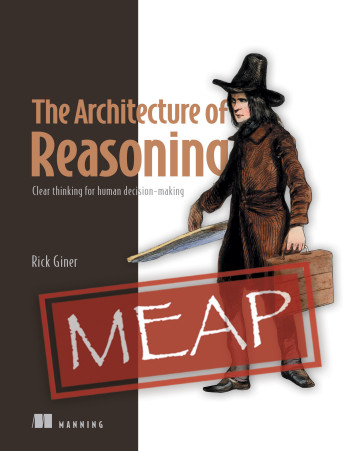
For the past several months I’ve been working on a stealth project with Jonathan Gennick and Erik Pillar of Manning Publications: a new book, The Architecture of Reasoning, by Rick Giner. Rick is Head of Engineering at Equiem and lives in Melbourne, Australia.
There isn’t a polished elevator pitch for the book yet, so here’s my attempt. The Architecture of Reasoning sits at the intersection of engineering leadership, design patterns, and cognitive science. Clear as mud, right? Let me make it concrete.
The book identifies common problems that surface when leading projects, like premature convergence on decisions. It then offers reasoning patterns leaders apply to steer those projects toward better outcomes. For premature convergence, a remedy is the Tree-of-Thought pattern: deliberately holding off on settling upon a solution while the team explores alternatives, so the final choice is the best one rather than the first one. We’ve all been in that meeting. Someone pitches an idea, the room rallies behind it, the decision is made, and months later we learn a better option was on the table all along.
There’s a useful precedent here. The foundational software book Design Patterns: Elements of Reusable Object-Oriented Software, by the “Gang of Four,” borrowed its core idea from a book about a completely different field: Christopher Alexander’s A Pattern Language: Towns, Buildings, Construction. Applying Alexander’s architectural patterns to software started a revolution. Engineers gained a shared vocabulary (Singleton, Iterator, Observer) for talking about design choices, and those terms are now common vernacular across computer science.
Rick made a similar creative leap. He took the reasoning patterns used to improve communications with AI and applied them to communicating with people. I was impressed when I read the initial book proposal and delighted when I was asked to serve as Technical Editor.
Normally I’d wait until a book is finished before sharing my thoughts, but this one is too good not to talk about now. Rick started strong, and I’m confident he’ll finish just as strong.
The first chapters are available now through Manning’s Early Access Program (MEAP): https://www.manning.com/books/the-architecture-of-reasoning
I hope you enjoy the book as much as we’ve all enjoyed working with Rick on it.
